Excluding Swap Files and Partitions
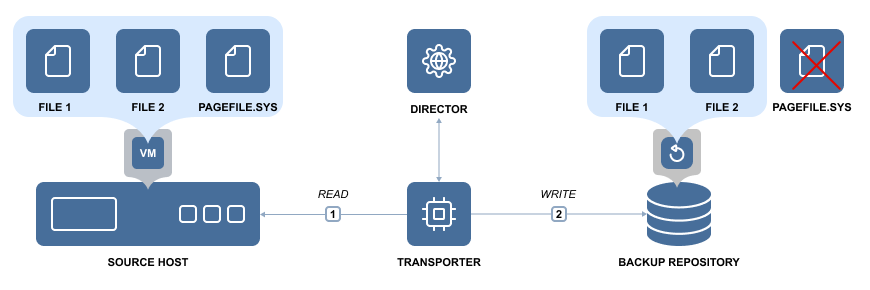
Swap files on Windows operating systems and swap partitions on Linux operating systems function as virtual memory and store temporary runtime data that is not actively used by RAM. These swap files and partitions improve operating system performance by allowing less frequently used data to be moved out of physical memory when RAM becomes fully utilized. This frees up memory resources for higher-priority tasks. While this mechanism benefits operating system and application performance, it has a negative impact on VM backup and replication.
Because the contents of swap files and partitions change continuously, they are included every time a VM backup or VM replication job runs. Since swap files can automatically grow to up to three times the size of RAM, large amounts of unnecessary data may be processed, transferred, and stored each time you back up a VM. Even in smaller environments, the impact can be significant. For example, backing up 10 VMs with just 2 GB of swap data per VM results in the transfer and storage of 440 GB of unnecessary data over the course of a single month (10 VMs × 2 GB × 22 working days).
NAKIVO Backup & Replication automatically excludes swap files and swap partitions in VMware VMs, Hyper-V VMs, and Amazon EC2 instances. This results in faster backup and replication jobs and reduces backup size. At the same time, application-aware mode ensures data consistency by instructing applications and databases running inside VMs to flush their data from memory to disk before the backup is created. As a result, all critical data is included in VM backups and replicas. This option can be enabled on a per-job basis.